
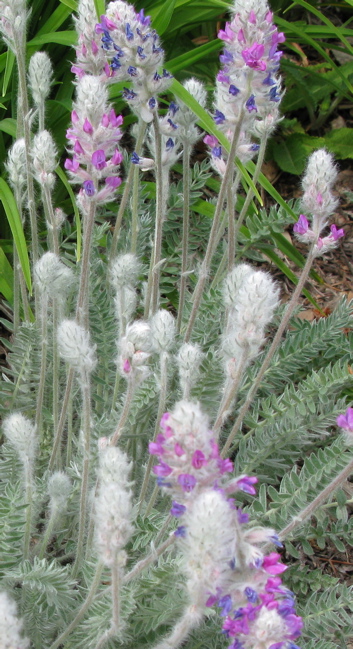
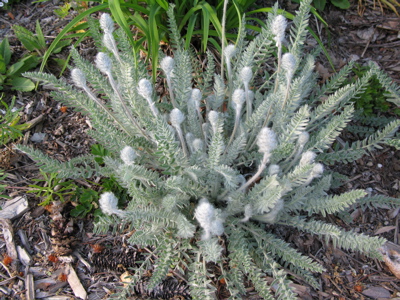
Our native Oxytropis splendens is certainly well-named! The dense covering of long silky hairs makes the entire plant look as though it's been dipped in silver. The scapes are delightfully furry (forgive my uncharacteristic gushing but they are as cute as baby animals!) and then as the flowers emerge, they are punctuated by the perfect compliment of bright pink-purple petals that dry to blue. It is even readily recognizable - I can't say that about all the oxytropis here - with the distinctive whorled leaflets! Bonus!
This plant turns some of the roadcut slopes in the foothills to fuchsia in season. Unfortunately, I don't have any good pix from the wild, so these from the garden (where it is perfectly well-behaved) will have to do for now.



Comments
Trond Hoy
Re: Undeniably splendid
Fri, 02/19/2010 - 9:34amHi Lori!
What a beauty! This one looks like taking freezing temperatures well?
Lori S. (not verified)
Re: Undeniably splendid
Fri, 02/19/2010 - 9:43amYes, it's a native plant that occurs across the Canadian prairie grasslands in areas where it gets to -45 deg C, as well as into the montane and lower alpine areas in the Alberta Rockies. According to the (loose) range description in Moss & Packer, it also ranges from Alaska, Yukon, Mackenzie District to Lake Superior and south to SE BC, New Mexico, North Dakota and northern Minnesota.
Here's the USDA range map:
http://plants.usda.gov/java/nameSearch?keywordquery=oxytropis+splendens&...
Trond Hoy
Re: Undeniably splendid
Fri, 02/19/2010 - 10:07amThanks! Looks as if this one will stand a real Norwegian winter! Do you know if it is possible to get seed anywhere?
Mark McDonough
Re: Undeniably splendid
Fri, 02/19/2010 - 10:08amI've seen photos of this plant that don't look nearly as beautiful as yours! It is indeed splendid. Regarding the species range, I always find problems with the USDA maps, invariably missing some portions of a plant's true distributional range. Whenever researching plants commonly found throughout the entire eastern half of USA, curiously they frequently omit showing these plants as being found in New England, when indeed they are. So, here is a link from the Natural Resources Canada site... it is very long, so I hope the link works. The map is "zoomable". I have also uploaded a screen capture where I zoomed into the eastern Canadian Provinces and northern New England, showing the species is found all the way to the East, maybe Todd will let us know if he's found it locally.
https://glfc.cfsnet.nfis.org/mapserver/phmapper/map.phtml?LAYERS=56014,5...
Lori S. (not verified)
Re: Undeniably splendid
Fri, 02/19/2010 - 10:17amWow, thank you for that link, Mark! I will definitely be bookmarking it. (How ironic that it is not one that I have already.) Needless to say, I had no idea of the full distribution of O. splendens, either! (I did note that the USDA maps can tend to exaggerate the range by "suggesting" that a plant may occur through an entire state or province when it may only sneak into a corner of it, or be restricted by habitat.)
Trond, I'll check if I still have seed left, and can send you some if so... or
next yearin late summer/fall, if I have none left.Todd's comments will likely be helpful re. climate preferences for this one... (something we have talked about previously).
Mark McDonough
Re: Undeniably splendid
Fri, 02/19/2010 - 10:30amYou're right, if a plant even just pokes its nose into the one tiny corner of a state like... Texas, the entire state gets shaded green in the UDSA maps. Look at the link I gave, and you'll see that the range down the Rockies into southwestern USA is much more spotty than the shaded-by-state map would indicate. I'm not sure how the USDA vets their information on maps, but almost always when I check them out, I find major omissions in the cited distributional ranges. I thought it interesting that O. splendens is found in upper New York State, Vermont, New Hampshire, and Maine.
Trond Hoy
Re: Undeniably splendid
Fri, 02/19/2010 - 12:05pmThanks! I appreciate that!
Panayoti Kelaidis
Re: Undeniably splendid
Fri, 02/19/2010 - 3:56pmOxytropis splendens occurs in great abundance all around South Park (which we shall traverse the Monday of this summer's conference) and above treeline all over the Mosquito and Sawatch ranges, which will be where our field trips take place. I think it will be virtually impossible to attend this meeting in July and NOT see hundreds if not thousands of this plant: a good reason to attend, no?
Anne Spiegel
Re: Undeniably splendid
Sun, 06/06/2010 - 4:40pmPanayoti, you're making me almost regret that we'll be in the Dolomites during the Salida Conference. I do miss the Mosquitos and its surroundings.
Panayoti Kelaidis
Re: Undeniably splendid
Wed, 06/09/2010 - 2:53amThe Dolomites, eh? I feel so SORRY for you Ann!
I'd feel sorrier if an old friend of mine hadn't married an Italian who has a home in the Dolomites and has invited us to visit! Hurrah!
Trond Hoy
Re: Undeniably splendid
Wed, 06/09/2010 - 10:31amThe seed I got from Lori germinated like cress and I have already planted out some not so small plants with even larger roots.
Anne Spiegel
Re: Undeniably splendid
Thu, 06/10/2010 - 9:30amWhen will you be there? You will go out of your mind if you're there for alpine bloom time. Think of a rocky alpine meadow with Sax. oppositifolia and Thlaspi rotundifolium growing like cress!
cohan (not verified)
Re: Undeniably splendid
Tue, 02/22/2011 - 12:06pmI have some unsown wild collected seed (and wild photos I'll dig up later, though no fuschia vistas where/when I have been).. did you do any pretreatment, Trond? or was it just warm germinating?
Trond Hoy
Re: Undeniably splendid
Tue, 02/22/2011 - 1:07pmI sowed some in situ but most in pots indoors with artificial light but no extra heating or other treatment. Quick germination. Planted them out at my mountain cabin last summer and had some really nice plants last fall. Now I wonder how they overwinter!
Lori S. (not verified)
Re: Undeniably splendid
Tue, 02/22/2011 - 2:17pmScarification can usually hasten the germination of any Fabaceae seed. I scarify all Oxytropis, Astragalus, Trifolium, etc. by rubbing the seeds across a fine half-round
rat-tailfile before sowing on moist medium... works very well!cohan (not verified)
Re: Undeniably splendid
Tue, 02/22/2011 - 11:25pmHow picky is this process? One seed at a time carefully? Or are you able to put a number on the file at once and rub quickly? I've heard of putting sandpaper on the bottom of a vessel and shaking seed back and forth, not sure how good contact is like that...
Though if Trond got good germination with no scarification....
Todd Boland
Re: Undeniably splendid
Wed, 02/23/2011 - 2:44pmBreaks my heart that I cannot grow any western Oxytropes or Astragulus in my garden....there are so many beauties that exist!
Lori S. (not verified)
Re: Undeniably splendid
Wed, 02/23/2011 - 7:00pmSome Fabaceae have thick, hard seed coats that take a long time to soften up (or just get moldy) so scarifying is very helpful especially for those. The scarifying is easily done just by picking up a few or couple of seeds on a moistened fingertip and rubbing them along the file a bit (be careful not to grind the softer ones into dust! :P) Bigger seeds can be nicked through the seed coat with a blade or fingernail clippers. I'm never planting more than a few seeds of anything so it's not too time-consuming.
cohan (not verified)
Re: Undeniably splendid
Thu, 02/24/2011 - 2:24pmI know some are espeically tough, and probably need scarification or a lot of patience, others are listed as 'easy warm germinators' though not all species are listed anywhere ;D I'd like to plant a lot more than a few of some of the natives, no doubt some experimenting is in order...
McGregorUS (not verified)
Re: Undeniably splendid
Sat, 02/26/2011 - 2:06amHi Lori
Love the Oxytropis - it is very pretty. If you collect any seed this year I would love some.
I quite agree with all your comments on scarifying. If I do it lupins and Astragalus germinate, if I don't, they don't. I just use very fine sandpaper and usually try an hold each one and just rub it across the paper. And that is OK unless the seeds are really small when it gets a bit more tricky.
Just getting Lupinus argenteus seedlings appearing from this year's seed exchange - very first of all my selections to germinate.
Anne Spiegel
Re: Undeniably splendid
Sat, 02/26/2011 - 5:05amScarifying definitely works with the pea seeds. I use a fine sandpaper in a sheet and rub the seeds, a few at a time, over the sheet with my fingers. The seeds get scarified and so do my fingertips! I love the larger seed which can be nicked with an exacto knife.
Lori S. (not verified)
Re: Undeniably splendid
Sat, 02/26/2011 - 7:09pmYes, I always get lots of seed so I will surely send some! I am told that the form that occurs in this area is quite a good one, being especially furry and silvery (and as I google around and look at photos from other areas, I'm inclined to agree).
cohan (not verified)
Re: Undeniably splendid
Sat, 02/26/2011 - 9:02pmI was actually going to ask if you had noticed different forms--I would agree that the forms I have seen and collected from are definitely very fuzzy and silvery, but flowers are not that showy--I think I have seen pictures of plants with much larger/showier flowers--maybe from farther south/east?
McGregorUS (not verified)
Re: Undeniably splendid
Mon, 02/28/2011 - 10:12amLori
That would be great - been editing so not looked at the forum for a couple of days so I'm a bit slow saying thanks.