David
As my wife Clare and I were having COVID-19 catalyzed discussions about whether it made sense for us to leave North Carolina and relocate nearer to family, the subject of the garden was raised. Our Chapel Hill garden, which had undergone a five-year makeover, including the addition of two crevice gardens, was our place, important to us. A place to do satisfying work and a wonderful environment to relax and enjoy ourselves. A decision of family vs. garden didn’t take long to make: “we can easily build a new garden” was my assessment (it must have been the wine talking). The decision to move to Georgia was made.
We ended up buying a newly built house, complete with three different types of sod laid over builders’ rubble and compacted Georgia clay. A full-on new garden? In the cold light of day, it is not that easy!
However, as we planned the garden, the one constant was that we wanted another crevice garden at the heart of it. The harmony of plant and stone was too much to resist. Our previous two crevice gardens had been built by Jeremy Schmidt, and we had established such a good rapport that I was convinced we could plan a garden from a distance. The design could be an iterative email process and I could get a contractor to do the prep work. Because Jeremy had already taught me how to select and buy stone he could then just drop by for a few days and do his magic. I put the proposal to him and was absolutely delighted when, with great enthusiasm, he accepted the challenge.
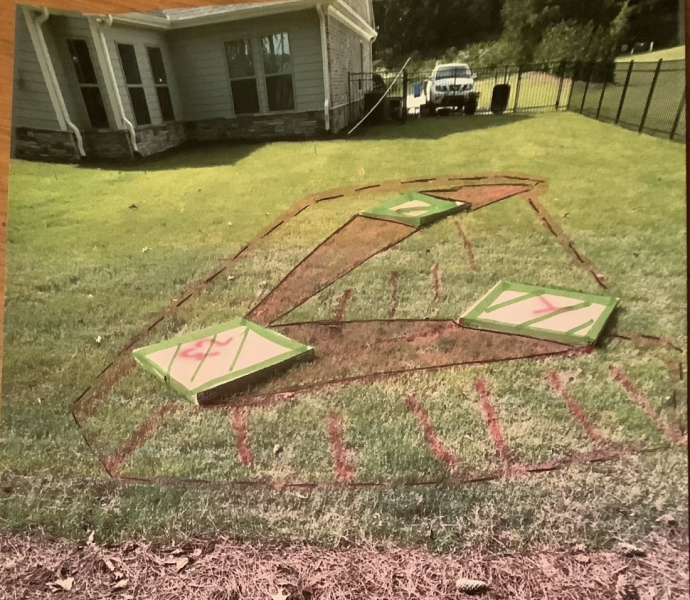
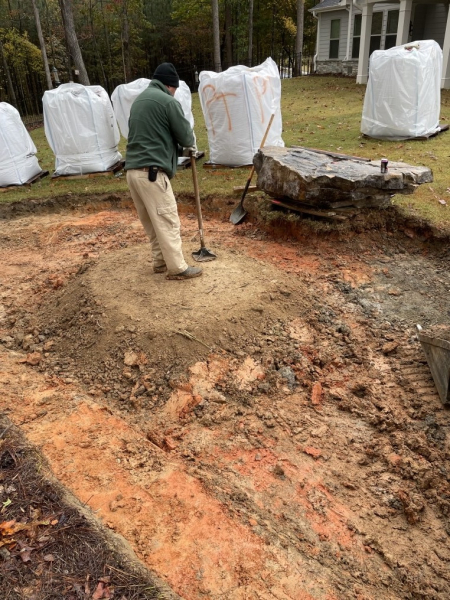
We talked in a relaxed manner about many design topics. The problem I was having was determining the position of the crevice garden relative to other elements of the garden we wanted (herbaceous perennial border, herb garden, woodland garden, Japanese stylistic area). The design tool that helped resolve this was big cardboard boxes and turf marking paint. This visualization process identified the sweet spot in a garden that only had a high to low drop of about four feet (1.2 m).
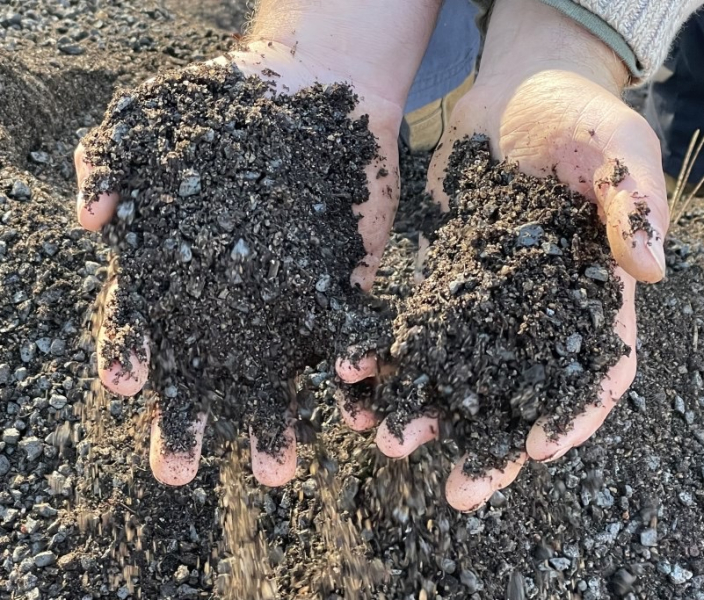
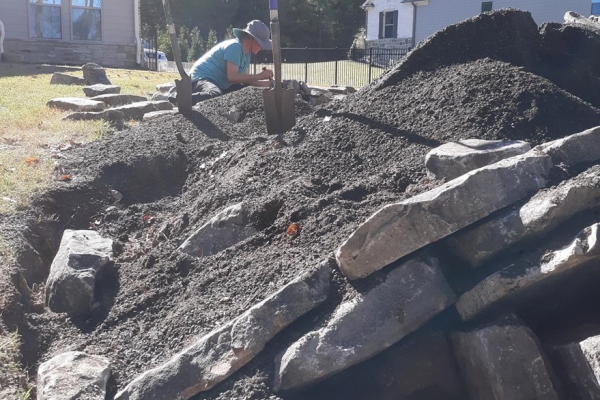
Jeremy, through a bit of detective work, identified the only bulk source of Permatil (a heat-expanded slate) in the state which, fortuitously, was also a good source of bespoke planting medium. We ended up with 28 cubic yards (21 cubic m) of a Permatil (44%), river sand (28%), worm castings (28%) blend.
Our previous two crevice gardens had allowed us to develop a great way of working. We jointly agree the big design points as Clare and I declare the things we would like to incorporate and Jeremy reflects on the art of the possible. After that I become a rudimentary laborer and coffee maker, and Jeremy does what he does best: stack stone.
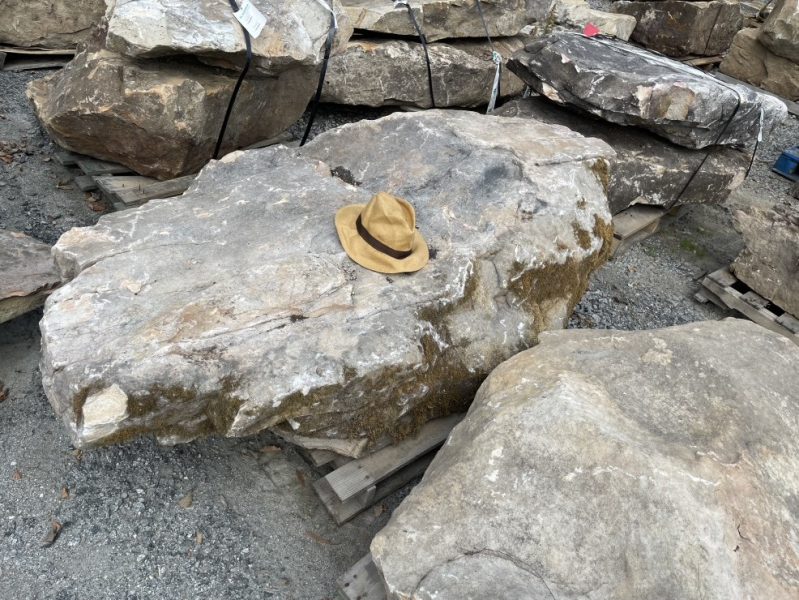
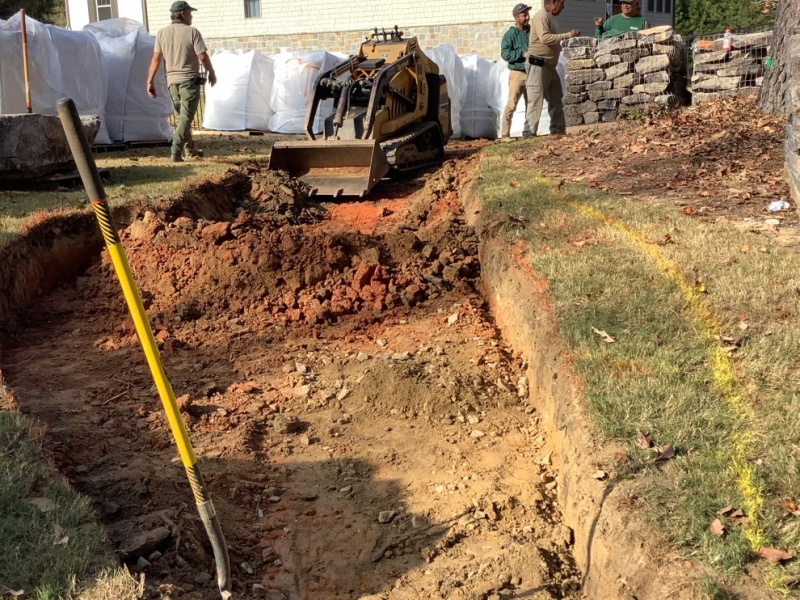
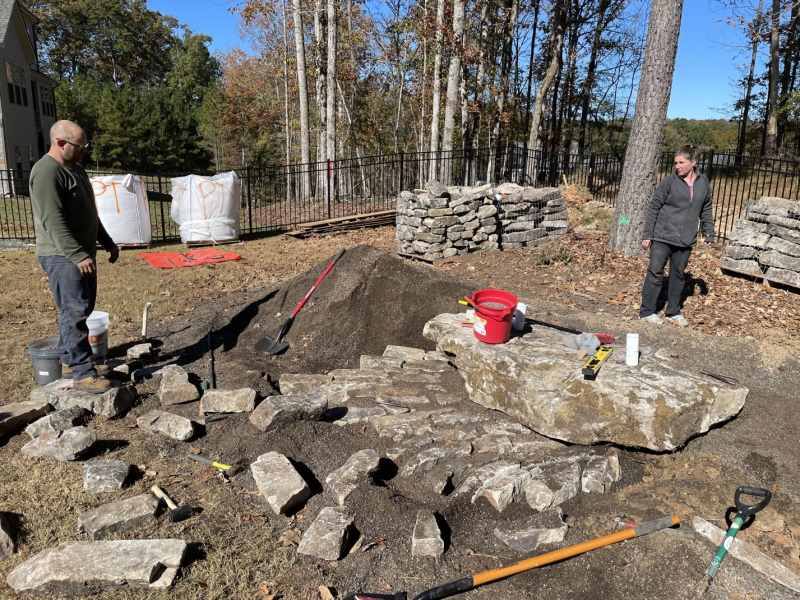
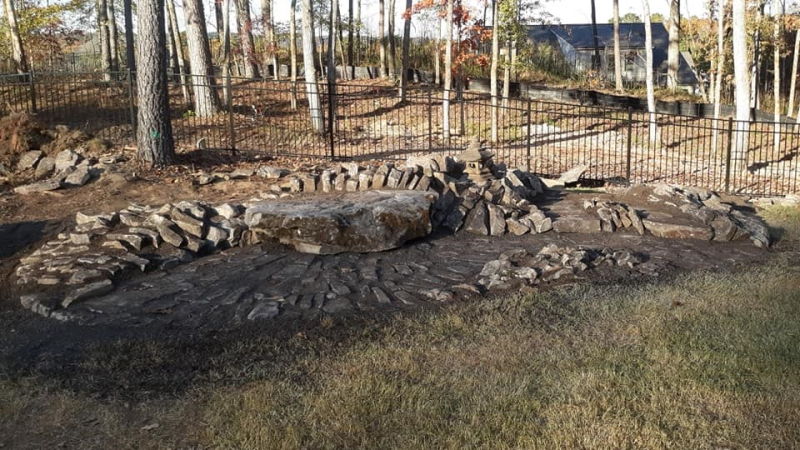
We agreed on the foundation design. An eighteen-inch-deep (45 cm) cavity that sloped up to twelve inches (30 cm) at the edge would define the work perimeter. A 3000-pound (1360 kg) flat boulder would be positioned to act as a “sitting stone.” Clare and I are both fond of the Burren in the west of Ireland so we wanted to incorporate klints (also spelled “clints,” blocks of limestone that make up the iconic pavement of the Burren). As much as possible we wanted this to be toddler friendly as our granddaughter would be a frequent visitor. Jeremy suggested six pallets of stone would do the trick.
After a little anxiety, two days before what we called “J-Day,” the pre-installation preparation had been completed and Jeremy gave me the good news: his better half, Meghan Fidler, a great stone stacker in her own right, was also coming to Georgia. We were off!
Jeremy
Just a couple of hours after participating online in the February 6, 2021, NARGS Rocks Crevices virtual study day, I received an email from David informing me of his and Clare’s decision to relocate. Over the past two decades, the Pulmans created a beautiful stone-based garden, and they had recently commissioned two of my best crevice creations. Suddenly, their exceptional Chapel Hill garden and my part in it was changing hands…but that’s love in the time of COVID. And in the very next sentence, David invited me to build a crevice feature as a centerpiece in his new garden. Yes…of course, yes! Is there any other reasonable answer to such a proposal? It must have been the beer talking. The decision to travel to Georgia was made.
From Valentine’s Day through Halloween, months of emails and phone calls transpired—as if tossing a ball back and forth over a very high wall—all planning our great escarpment. I never felt less than confident about the early November culmination. I had worked with the Pulmans enough to know I would arrive at a worksite approximately like we both imagined, and with lots of great stone. And it was on!
Day Zero
In the waning light of our travel day, David and Clare gave Meghan and me a 360-degree tour of their new home and future garden. During our preamble amble, we were introduced to a wonderfully prepped worksite, complete with a central, optimally pre-set boulder, ready for a crevice garden. That night in the hotel room, I imagined ways to create the most improbable and aesthetically appealing natural design in the space and timeframe provided. I fast-forwarded through millennia; I witnessed natural forces pushing, bending, folding, and weathering the crevice formation up to present day, and then watched the plantings mature for the next five years. I built and bulldozed the Pulman’s crevice garden several times that night in my mind. Meghan says I dig in my sleep. It’s probably true.
Day One
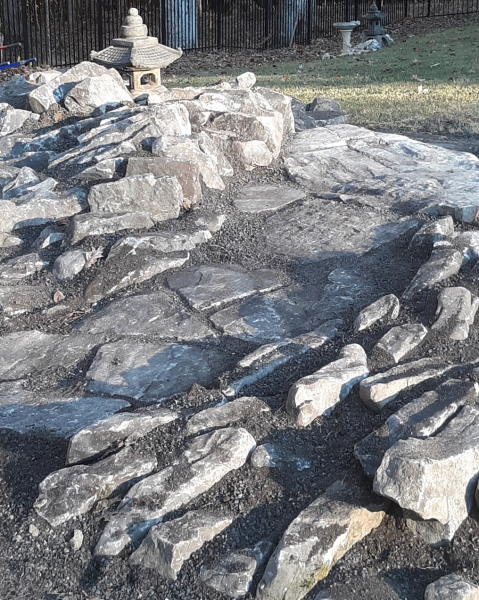
Six pallets of stone were staged conveniently adjacent to the worksite. David sent me several pictures of crevice and klint stone options from a large Atlanta area supply yard. We settled on three stone shapes, all branded as part of the Tennessee Fieldstone series, and all apparently from the same quarry. Three pallets of Capstone provided the main body of the crevices. These stones ranged somewhere between stout quadrilaterals and isosceles triangles, averaging 30-200 lbs (13 to 90 kg) each, and five to eight inches (13-20 cm) thick. Two pallets of Long Stack were flagged for use as steppable, plantable, klint stones. These were consistently French-fry-shaped, and five to twelve inches (13-30cm) thick depending on orientation. Finally, one pallet of Medium Veneer was selected primarily to define the edges in conjunction with the large stones. These were three to six inches (7.6-15 cm) thick and 10 to 50 lbs (4.5- 23 kg), really just a smaller version of the Capstones. Three shapes and sizes of stone, all from the same quarry, and possessing handsomely weathered-but-squared faces and edges.We could not have custom ordered more optimal crevice stones. All that just to describe our rocks?! Yes. Day one, we cut the cages—thus activating the stone.
Accompanying the placement of the first stones was an hour of ritualistic pacing, pondering, and face-scrunching. I’ve learned from experience that 25% or more of the total crevice installation will share similar spacing/orientation/dialect with the initial five-or-so contiguous stones. So, when we stacked the first stones, we had already mentally committed to the macro-concepts of the installation.
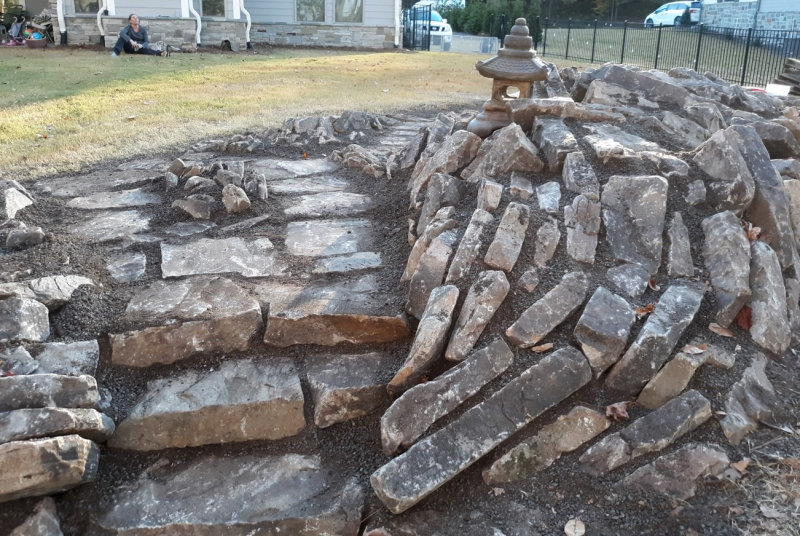
For this project, the klint was the obvious starting point. We took our time determining how the klint would interface and aesthetically elevate the large, central boulder—and then how the klint would transition into raised crevices. By the time we stacked the first five klint stones, we had committed to the grain, spacing, and location of one-third of the total square footage of the project. By the end of the first day we had set about 50 stones, all as part of the klint.
Day Two
For two reasons, we ignored the klint at the start of day two. We focused our efforts instead as far away from our first day’s work as possible—stacking raised crevices at the downhill extent of the installation. Reason one: after spending an entire day to move through only about 50 stones, our calculated pivot bypassed the “stackers block” we encountered the previous afternoon. Shifting our location within the crevice garden footprint provided an instant plethora of easy stacking choices; and suddenly the project was moving as fast as we could place stone. Reason two: by stacking from low to high, each consecutive stone was ready to support the next stone—a valuable lesson I’ve had to learn more than once.
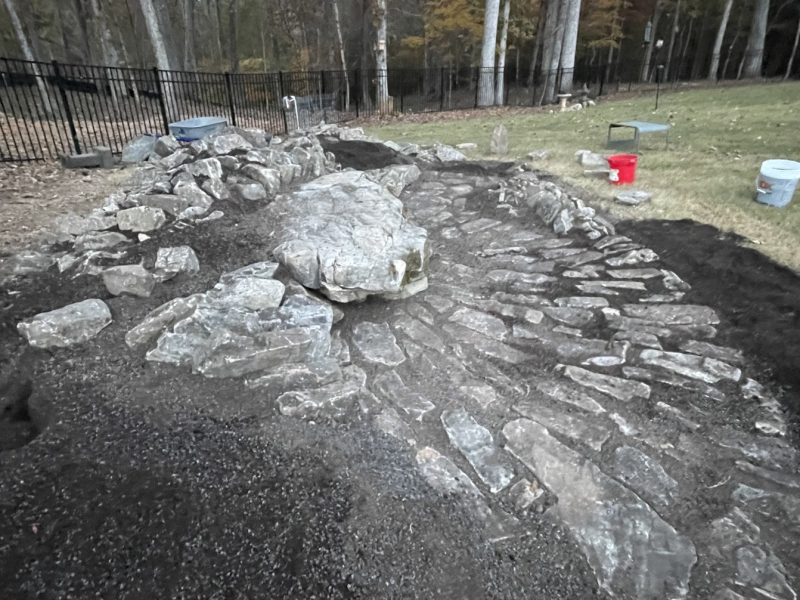
After we bent and folded several stones into place, Meghan discovered an opportunity a few feet away to incorporate a small rubble island of misfit rocks. Separated from the main crevices by the walkable expanse constructed during day one, the small feature added a measure of balance to the large central boulder, and gave a voice to stone less likely to fit elsewhere in the project. She even re-homed a few “impossible-to-stack” quartz rocks native to the property. I’ve had excellent success with similar small rubble accents in previous crevice installations, including at the Pulmans’ former garden. When done right, a patch, a vein, or a pocket of rubble is no less aesthetic or plantable. And Meghan stacked it right. Joined together, “unusable” stones serve to heighten the story being told, all while stretching stone supply.
Another 80 puzzle pieces registered, and a bigger picture began taking shape. Like long brushstrokes, stones reached out to make first contact with the central boulder. And, out of nowhere, rocks conjured stairs and a bisecting path. Edges were becoming defined. The space was evolving into place.
Day Three
To avoid blowing through all the ideal, easy-to-place stones before completion, I stacked through the stone supply as linearly as possible. To accommodate this tactical randomization, I non-selectively siphoned a few stones from each pallet into a small, 10-15 stone, queue available within arms’ reach of where I was working. The recurrent short-term objective was to empty the queue before staging the next stone amalgamation. Adhering to this discipline while freely skipping around to multiple stacking points guarantees consistent material supply throughout the duration of crevice garden installation. I’ve found that this practice not only supports a healthy supply chain, but also facilitates an unlikely alliance between capricious creativity and laser-focused objectivity. More specifically, if stone choices for the stacking challenge at hand are restricted only to what is within reach, then the meticulous comprehension of each stone’s shape and attitude is also within reach. A boundless imagination can apply this detailed short-term memory queue to execute perfect stone combinations. Whereas, to select the “perfect” stone from the pallet is rather short-sighted in comparison.
Why such a protracted and roundabout introduction to day three? Because we were halfway through our stone supply and halfway through the project. If we had been cherry-picking in the first two days, we would already have run out of cherries. With the exception of making short work of the Long Stack stones to finish the klint, and setting aside a few large stepping stones, we were systematically slicing through stone pallets like one would slice through of loaf of bread.
Also, Day Three
Mentally and physically—and more so emotionally—day three was unavoidably a difficult haul. Physical exhaustion can be mitigated by redistributing the load across a network of 600 muscles, but there is only one brain to conduct their orchestral movements. Somewhere beyond the halfway point of every multi-day crevice construction project I’ve completed, whether over a span of four days or over two years, momentum stalls, and a doldrum settles in. Mental vision blurs as completion remains elusively out of sight. Every inch of progress requires willpower, muscle memory, discipline, and an exaggerated deep breath between the placement of each stone.
Stacking challenges intensified during the second half of the Pulmans’ crevice project. We were faced with compounding constraints like uniting disjunct stacking points into a contiguous crevice garden. No more skipping around from point to point. We had to close out sections we avoided earlier. Regardless of how delightful the Tennessee Fieldstone was to have and to hold at the beginning of the project, some muscles were as worn out as my Pearl Jam playlist on Pandora. It became more difficult to stay receptive to the unique details and personality each rock had to offer to the story we were stacking. By lunch the third day, we weren’t running low on great stones, we were running short on mental bandwidth. The sun advanced as it does across the southern November sky, while Meghan and I pressed on to the best of our ability. We moved one stone at a time; we spoke to each other one word at a time. Day three was really just one quarter of the project timeline, but it felt much longer. Yet each piece was placed with great care and consideration—there was no compromise. Another stone set…a pause for Clare’s ham and cheese sandwiches on multi-grain bread, sliced diagonally, with crust removed…a diet soda…a deep breath…pick up another stone from the queue…a granola bar…a sip of David’s scalding hot afternoon coffee...and then a deep breath. Another stone set. By the time the shadows stretched across the crevices late that afternoon, the end was in sight.
Day four
What could possibly be more important than the first 95% of the project? Answer: the final 5%. After all, if the last few stones are noticeably thrown together in frustration or surrender or haste, the entire crevice garden will be defined by that small percentage of futility. If the final decisions are enacted with similar confidence and passion as when the first stones were liberated from their cages, then a unified story is told. If no one can point out the last few stones in the project, I take it as a good sign.
With the completed project close at hand, we hit day four with renewed energy, our brains were synchronized and sharp. We were as hungry to close out the final voids as we were to stock our opening statements on a clean slate. There was a granddaughter ramp to engineer behind the central boulder for high-speed toddler access, but the main challenge of the day was to shovel 1.5 cubic yards (1.1 cubic m) of surplus crevice soil out of the way of the final edge and crevices. David helped us greatly with hauling the soil mix further to the side, closing out the klint, and with laying several steppers for the ramp. We also worked with David and Clare to select, move, and place a toro (Japanese stone lantern) at the apex of the crevice garden. They had transported three such stone lanterns from their previous North Carolina garden, so we had three to choose from on site. Clare was right—the first toro we chose was too large for the space. We took a breather, regrouped, and moved a slightly smaller toro into place. The day was delightfully punctuated by a visit from premier horticulturists Lisa Bartlett and Ozzie Johnson—the Pulmans new crevice garden was already drawing people together! Lisa and Ozzie dropped off a beautiful Japanese native Allium kiiense as a crevice warming gift. By noon on day four, we finished the project, opening the next chapter in the story of these stones.
David and Clare’s investment in the planning and preparation, and our ongoing communication ensured that we were on the same page from the start. In the context of love for family, and a passion for nature, David and Clare provided very clear expectations of how they intended to inhabit the central rocky feature; and immersed in an environment of non-stop hospitality, we were supplied with exactly what we needed to accomplish the Pulmans’ goals. Truly, Meghan and I are honored to be a part of this garden. These stones were drawn together to tell the story of family—from the ground up.
David’s last word
With the physical crevice garden complete (everyone who visits is mightily impressed) it is time to turn attention to the planting— in my mind something equally difficult! I have brought my list of plants that did well in North Carolina, which is a good place to start. There will be a trawl of the market place but any suggestions from NARGS members will gratefully be received!
Time is not infinite as there are the other elements of the garden to be installed and then planted up. This will be a more stressful process as in addition to “doing a garden” I have to build relationships with the contractors from scratch. I anticipate a more hands-on process and if you wish to follow progress then check out the blog at AndAllenGarden.com.
No matter how it all turns out, this is a lot of fun!